
Culture of High Performance T eams
Build a culture your best people choose to stay for
We help founder-led and family businesses across Australia and New Zealand build cultures of high performance on purpose. Grounded in applied neuroscience and more than three decades of running businesses. Built with your team, not handed to them.
Culture happens either way
Every business has a culture. The only question is whether you built it on purpose, or it formed on its own while you were busy running things.
When it forms by accident, you feel it. Good people leave. The same conversations go round in circles. Everything still runs through you.
When it is built on purpose, people feel they belong, that they are trusted and that they matter. They stay longer , step up without being asked, and do their best work with less stress.
The weight leaders carry
Most founders don’t talk about it. The numbers do.
- Nearly one in three Australian small business owners (31%) have considered giving up their business because of stress. In New Zealand, it is 47%.
- 58% have hidden that stress from their f amily or partner .
Source: Xero Emotional T ax Return, Australia (May 2026) and New Zealand (February 2026).
That weight doesn’t stay with the leader . It travels into the business.
- 40.4% of Australian leaders surveyed by the CEO Institute say execution is inconsistent and depends heavily on individual leaders or teams.
- The biggest people constraint they report is managers stretched too thin to coach, prioritise and support their teams: 26.8% in Australia and 39.1% in New Zealand.
Source: CEO Institute Pulse Report (September 2026).
A culture built on purpose is how that load gets shared.
Why this isn’t a nice-to-have
Culture shows up in the numbers. A genuine culture of high performance:
- attracts the right people and keeps them
- wins work, because clients can feel it before they sign
- lifts profitability and market share
- takes the weight off the founder
The commercial case is usually why culture work starts. What people experience is why it lasts.
What we believe
When you employ someone, you take on responsibility for the whole person, and in many ways their f amily and community too. Look after people properly and performance follows. Chase performance at the expense of people and you will rarely keep either for long.
How we build it
Our process runs in five phases. Each one builds on the last, and your whole team is involved, not just leadership.
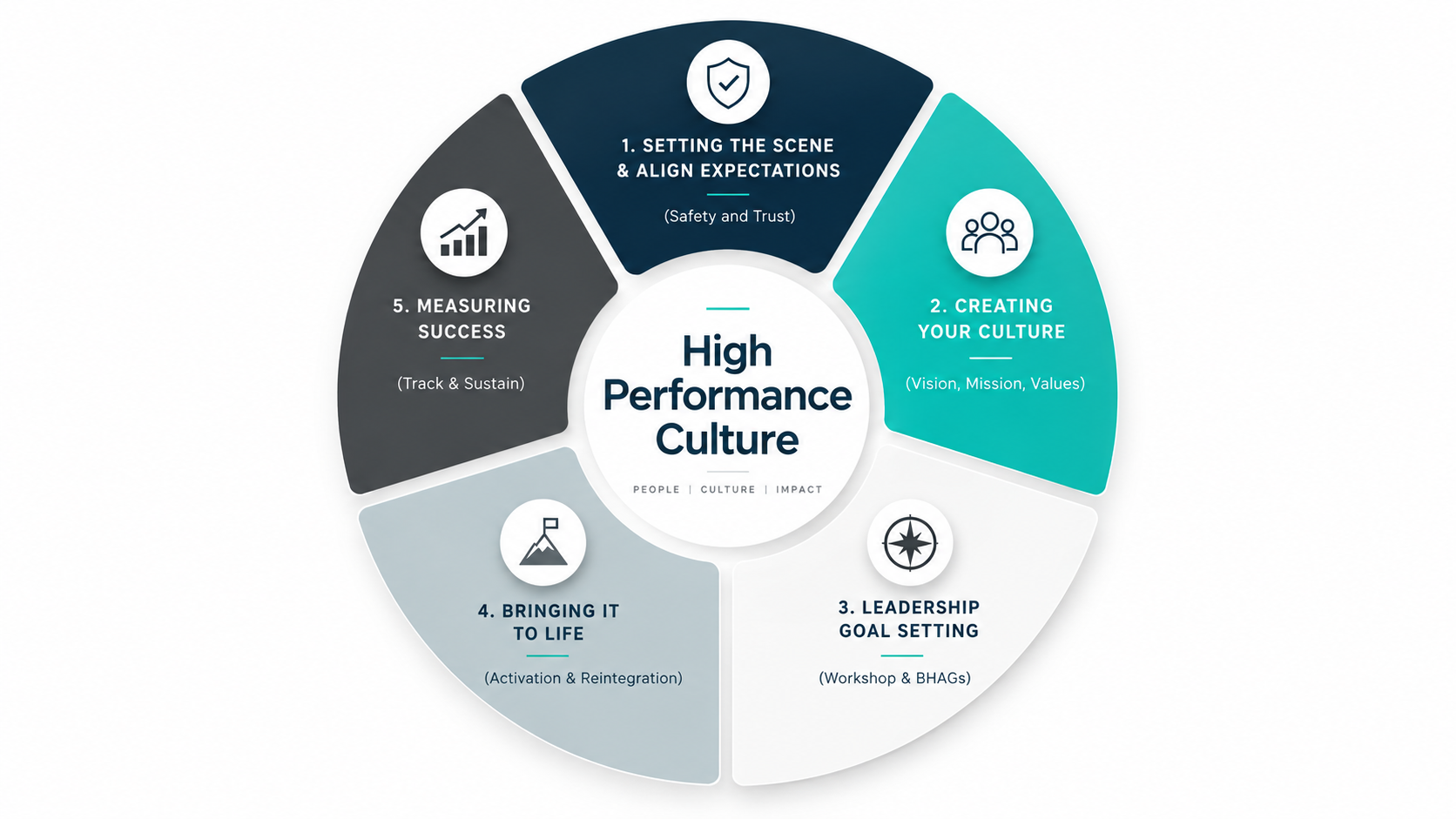
- Setting the scene: foundation and psychological safety. We start by making it safe to be honest. People won’t build something they don’t trust.
- Creating your culture. Your team shapes the values, behaviours and standards together , so they own them from day one.
- Leadership workshop. Your leaders work out how to model the culture, hold courageous conversations and set the direction for the years ahead.
- Bringing the culture to life. We turn values into everyday habits: culture ambassadors, recognition, recruitment and the way meetings and decisions actually happen.
- Measuring success: keeping it alive month by month. We track what matters, including eNPS, retention, peer recognition, psychological safety , and internal promotion and referral rates.
Why neuroscience matters here
People rarely change because of a good argument. They change when they feel safe, when they can see a better future, and when the next step feels clear and doable.
That is how we design every session. W e lower the sense of threat first, make new habits easy to adopt, and make progress visible, so the change sticks long after the workshops end.
What this looks like in practice
Ray White Austar
We worked with the whole team, not just leadership, to build the culture together. The change was gradual, then visible, then measurable: market share, recruitment, retention and client wins all moved. A few people who didn’t fit the new culture chose to move on, on their own terms.
“It wasn’t my culture. It wasn’t the owner’s culture. It was our culture, built by the team, for the team.”
Len Day , Ray White Austar
A small Salesforce integration firm, up against the big four for a New Zealand Ministry of Education contract. Rather than compete on size, they put their culture and values at the centre of their response. They won.
“Steve helped my previous company align our pitch for a government department RFP.”
Dan Fowlie, Trineo
Is this for you?
We typically work with founder-led and f amily businesses of around 15 to 200 people, across any industry . It is usually a fit when:
-
- you are growing, and worried about losing what made you special
- good people are leaving, or the right people are hard to find
- the values are on the wall, but not in the room
- too much still depends on you
Want to know more?
If any of this sounds familiar , let’s talk. Book a time that suits you, and we’ll have an open conversation about where your culture is today and where you’d like it to be.